The Vehicle Wrap Design Process: From Concept to Installation
Quick answer A wrap design starts with learning about your business, not with artwork. Our design team gathers your logo and ideas, builds a design around your actual vehicle, and sends a digital proof showing how it will look. You review it, we refine it until you're happy, and only then does it go to print and installation.
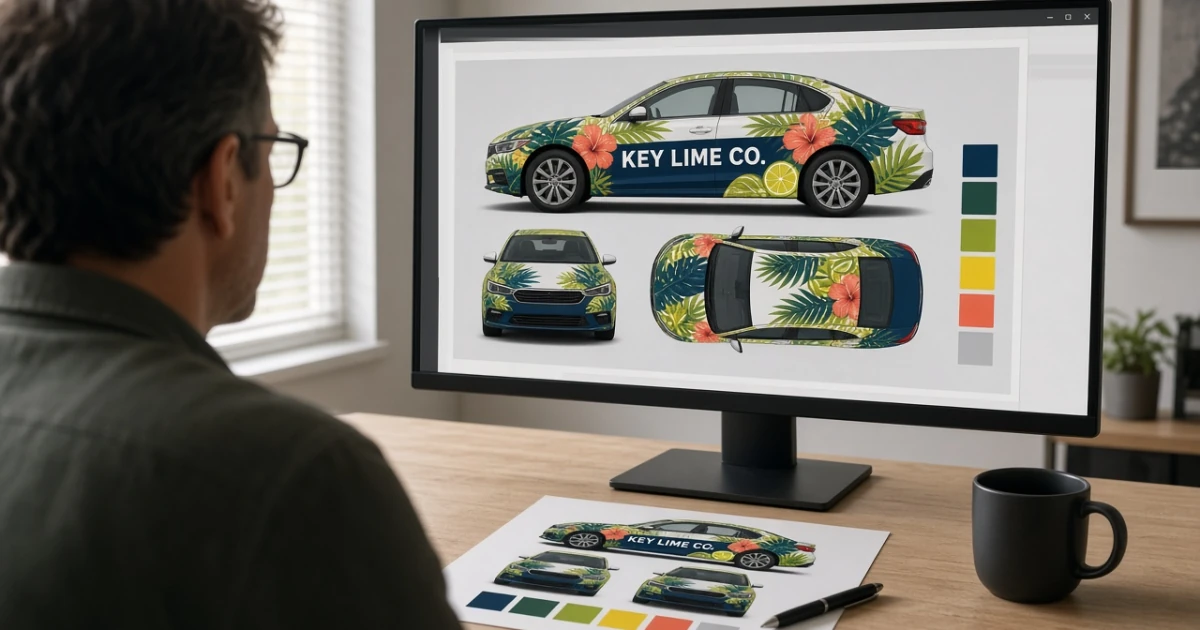
Good Wrap Design Starts With Questions
You don’t need to hire a graphic designer before contacting us. One thing customers tell us they appreciate is how easy the design process is, and that starts with a conversation, not a sketch. Before anyone opens a design file, we want to know who you are, what you do, who your customers are and where your vehicle spends its day.
Those answers matter because a wrap has a very different job than a business card or a website. It has to work on a moving, three dimensional surface, often for just a few seconds, in traffic or across a parking lot. Our goal is a wrap that communicates what your business does, who you serve and how customers can contact you, all within a few seconds.
So what do you need to bring to that first conversation?
What You Can Bring (Even If It’s Not Much)
Our in-house design team can work from almost anything:
- Existing logos or brand guidelines
- Your website, business cards or social media pages
- Photos of work you’re proud of
- Sketches, inspiration photos or wraps you’ve seen and liked
- New ideas developed from scratch
Don’t have much? That’s okay. We’ve started projects with nothing more than “I just want something modern.” If your logo is low resolution or you don’t have one yet, tell us. Logo and branding work is part of what our design team does.
Designing for the Road, Not the Screen
A design that looks great on a computer monitor can fail on a vehicle. Text that is easy to read on a laptop can disappear at highway speed. Door handles, fuel doors, windows, body lines and rivets all interrupt the surface. A good wrap designer plans around all of it.
A few principles guide almost every commercial design we create.
Hierarchy: One Main Message
One main message, usually your name or logo, should win at a glance. Everything else supports it.
Readability From a Distance
Phone numbers and websites need high contrast and enough size to read from a distance.
Placement Around Handles and Gaps
Key text stays off door gaps, handles and deep curves so it never gets cut or distorted.
Using the Vehicle’s Own Color
On a partial wrap, the paint is part of the design, not just background.
These Principles in Our Portfolio
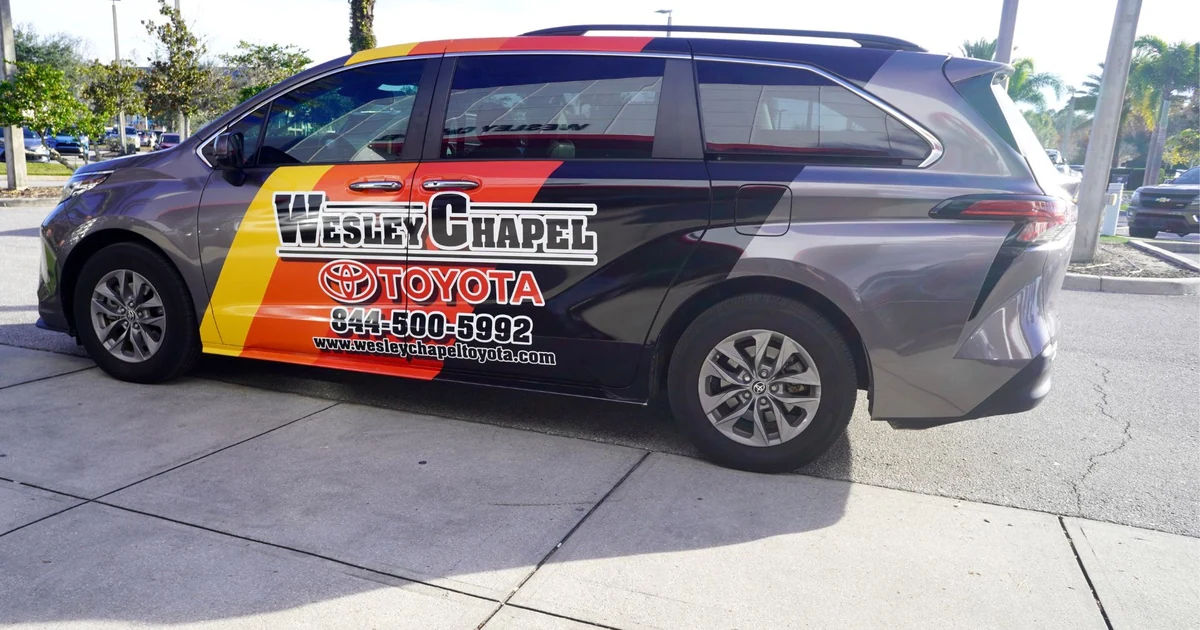
You can see these ideas at work in our portfolio. On the Wesley Chapel Toyota dealer van, bold black, orange and yellow bands sweep across the side doors, while the dealer name, logo, phone number and website sit inside them in high contrast, and the van’s gray paint frames the design. The bus wrap goes the other direction, with a large “Sweet Just Got Serious” headline and candy graphics across a purple background, built to be noticed from far away.
Your Digital Proof
Before anything is printed, you’ll receive a digital proof showing your actual vehicle, trailer or van with the proposed design, so you can see what the finished wrap will look like. This is where you check everything: spelling, phone numbers, colors, images, sizing and fonts.
Take your time with this step. Once you approve the proof, the design goes to print, and changes after approval can add cost. If you’d like changes, no problem. We’ll keep refining the design until you’re happy with it.
Designing Once, Using Everywhere
Your wrap design is also a brand asset that can carry beyond one vehicle. The Water Filter Warehouse project shows this well. The same flowing water graphic, logo and colors appear across the doors of a white car and on the front of a retail kiosk, so customers see one consistent brand whether they’re on the road or in a store.
The same thinking applies to fleets. If you plan to add vehicles later, tell us at the start. We’ll build the design so it adapts cleanly to trucks, vans and trailers. Our Commercial Fleet Wraps guide covers that in detail.
From Approved Design to Installation
Once the proof is approved, the design is prepared for production, printed on commercial grade equipment and laminated. Your vehicle is cleaned and prepped, and the wrap is installed panel by panel, then inspected. To see what that day looks like, read What to Expect During Installation Day.
A strong design is the part of the wrap people actually remember. It deserves real thought up front, and a good design process makes that easy for you.
Frequently Asked Questions
Have an Idea, or Just a Logo?
Send us whatever you have, even if it's just a rough idea, plus a few photos of your vehicle. We'll start the conversation and show you what's possible.